
Description
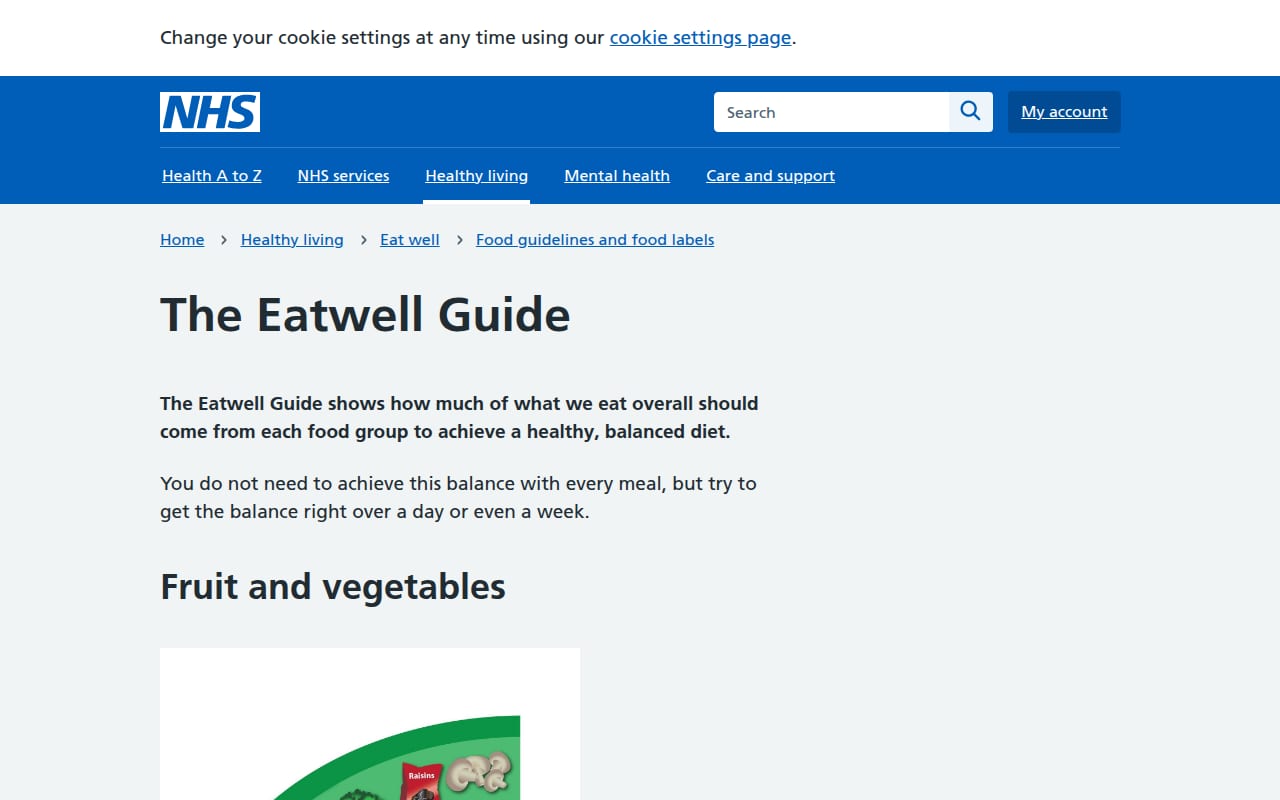
The Eatwell Guide is the UK government’s picture of a healthy, balanced diet, a plate divided into food groups, explained for free on the NHS website and published by the Office for Health Improvement and Disparities.
It was first published on 17 March 2016, replacing the older Eatwell Plate; the booklet was last revised in 2018, and on GOV.UK the references to Public Health England were changed to OHID in January 2024. Fruit and vegetables should make up just over a third of what we eat, at least five portions a day, with fruit juice and smoothies kept to 150 ml a day in total. Starchy foods make up another third, preferably wholegrain or higher-fibre. The rest is protein, with at least two portions of fish a week, one of them oily, and less red and processed meat; lower-fat, lower-sugar dairy; and small amounts of unsaturated oils. Foods high in fat, salt and sugar sit outside the plate, to eat less often. It also advises six to eight cups or glasses of fluid a day, and isn’t meant for children under two.
The guide and its PDFs are free under the Open Government Licence, and the NHS pages show no advertising. Related NHS pages explain the traffic-light labels on packs and what counts as one of your 5 a day.
Strengths
- It is the official UK reference, free and ad-free, and easy to read as one picture of a plate.
- The advice is concrete: five portions of fruit and vegetables, two portions of fish a week, juice capped at 150 ml.
- The NHS links it to practical pages on food labels and portion sizes that were reviewed in 2026.
Weaknesses
- The NHS page was last reviewed in November 2022 and its next review, due in November 2025, was overdue when checked.
- Writing in the BMJ blog in 2016, Atherton and Head said it doesn’t explain what sustainable eating means or recommend eating less meat overall.
- A 2025 review by Rayner, listed by Oxford Population Health, argued that the guide leaves much to be desired and should be revised.
Who it is for
Adults in the UK who want to check their meals against the official advice, and parents or teachers looking for a free, simple picture of a balanced diet.
Sources
- NHS: the Eatwell Guide, how to read food labels, 5 A Day: what counts (checked November 2026)
- GOV.UK: The Eatwell Guide
- BMJ blog: How environmentally sustainable are the UK’s new dietary guidelines? (2016)
- Oxford Population Health: Is the Eatwell Guide still appropriate for the UK?
- The Conversation: How reliable is the Eatwell Guide?