
Description
The DGE recommendations, “Gut essen und trinken”, are Germany’s food-based dietary guidelines from the Deutsche Gesellschaft für Ernährung, which since 2024 take the environment into account as well as health and set a limit of 300 g of meat and sausage a week.
The DGE is a non-profit scientific society in Bonn, founded in 1953 and funded by the federal agriculture and food ministry. Its 2024 guidelines were worked out with a mathematical optimisation model that weighs nutrient needs, health, environmental impact and usual German eating habits. They are meant for healthy adults aged 18 to 65 and give approximate amounts: five portions of fruit and vegetables a day, five portions of grain products, at least a third of them wholegrain, a small handful of nuts (25 g) a day, pulses once a week, fish once or twice, two portions of dairy a day and about 1.5 litres to drink, mainly water. Alcohol isn’t recommended at any amount. More than three quarters of the food should be plant-based.
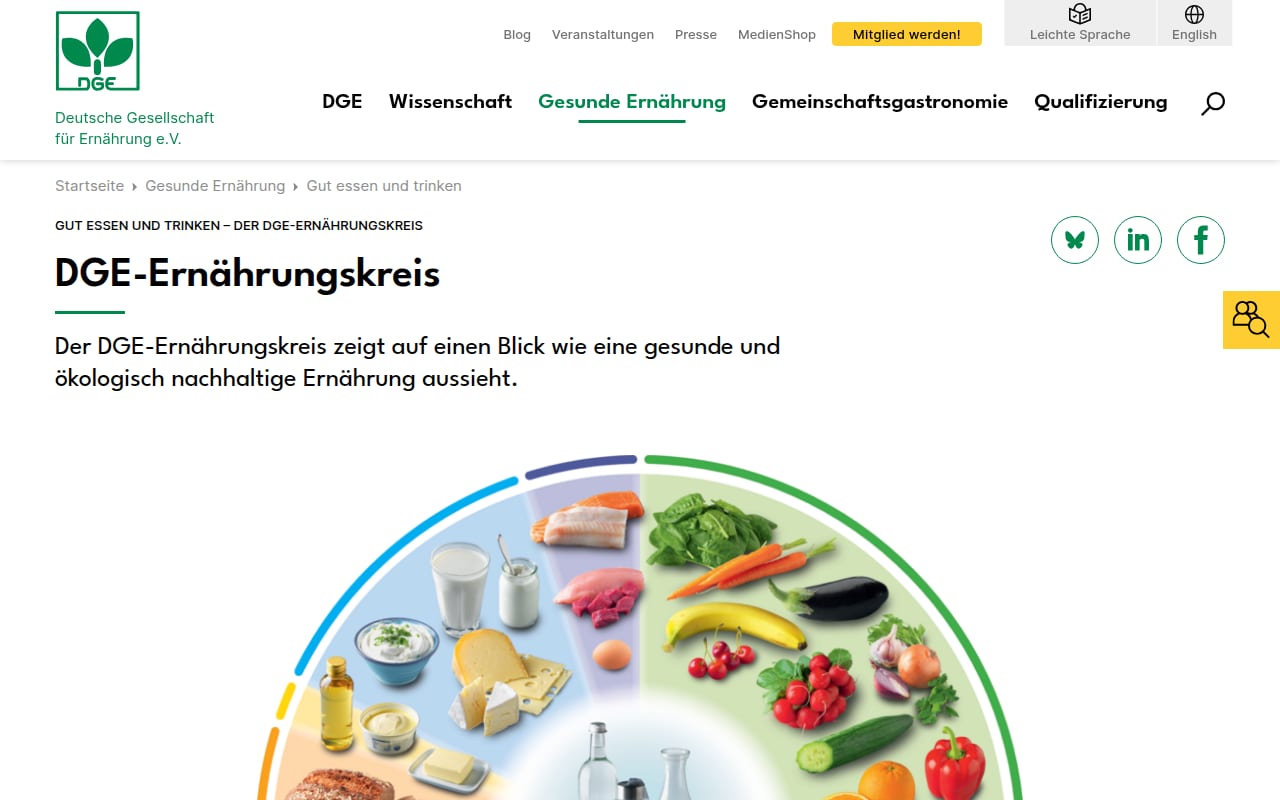
The earlier advice allowed 300 to 600 g of meat a week. ProVeg called the new limit a concession to the meat lobby, while dairy and farming associations objected to the cut in dairy. The recommendations, the DGE nutrition circle, info sheets and weekly meal plans are free on the website, which shows no advertising.
Strengths
- The amounts are concrete, such as 300 g of meat and sausage a week or 25 g of nuts a day, and easy to compare with one’s own week.
- For the first time they weigh environmental impact alongside health, using a published optimisation model.
- The guidelines, info sheets and meal plans are free and ad-free on the DGE site.
Weaknesses
- They are aimed at healthy adults aged 18 to 65, so children, older people and people with illnesses need other advice.
- They are criticised from both sides: as too soft on meat by ProVeg, as too strict on dairy by farming and dairy associations.
- The DGE is funded by the federal ministry, and the pages read don’t mention rules on conflicts of interest.
Who it is for
Adults in Germany who want a reliable reference for how much meat, dairy, grains and vegetables to eat in a week, and who are tired of contradictory diet advice.