
Description
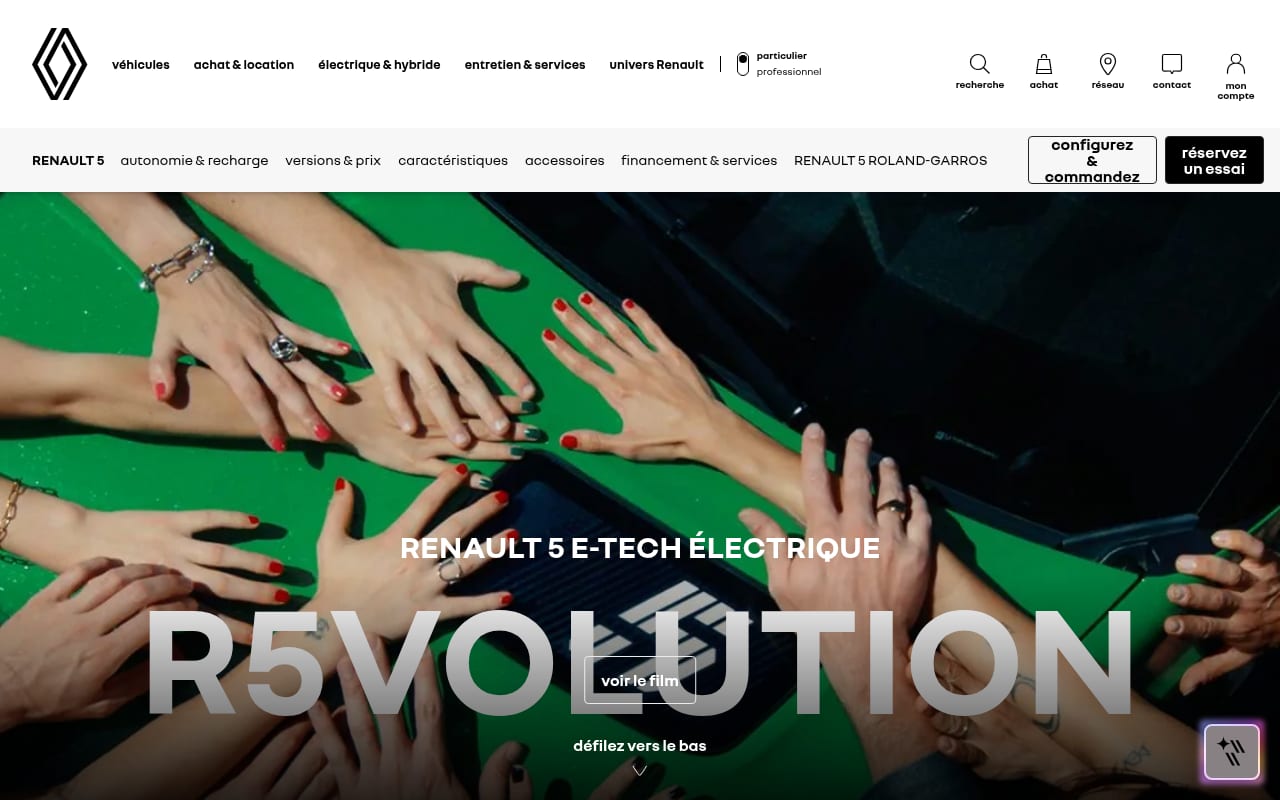
The Renault 5 E-Tech is a small electric car built at Douai in northern France since October 2024, with a range of 300 or 410 km depending on the battery. For households that can’t do without a car, it is an alternative to a petrol or diesel car, and to large, heavy electric SUVs imported from China or the United States.
The car and its battery are assembled at Douai, the motor is made at Cléon in Normandy, and since March 2025 the battery cells come from the AESC Envision factory at Douai instead of China. The batteries use NMC chemistry, hold 40 or 52 kWh and weigh 297 kg, and the car weighs 1,350 to 1,449 kg, light for an electric car. It charges at up to 11 kW on a home wallbox and 80 or 100 kW at fast chargers (10 to 80 % in about 25 minutes), and the more powerful versions can supply power back to a house or the grid (V2G). It carries the Origine France Garantie label.
In France prices start just under €25,000 for the 95 hp Five version and go up to €35,490, as announced in October 2024. It is eligible for the 2026 social leasing scheme for low-income households, at about €120 to €140 a month depending on the source, and for the energy-saving “coup de pouce” aid, whose amount depends on income. It was European Car of the Year 2025 and has received 44 awards, but scored four of five stars in the 2024 Euro NCAP crash test. Reviews criticise the narrow rear seats and the small space in the back.
Strengths
- Small and light for an electric car, so it uses less energy and fewer raw materials than an electric SUV.
- Built in France, with battery cells made at Douai since March 2025.
- Fast charging in about 25 minutes, and the ability to supply power back to the grid on the stronger versions.
Weaknesses
- A new car still has a large footprint: car-sharing, a bike or the train come first where they work.
- At €25,000 to €35,000 it remains out of reach for many households without the social leasing scheme.
- Narrow rear seats and little space in the back, and four Euro NCAP stars rather than five.
Who it is for
Households who can’t do without a car, drive mostly short and medium distances, and want to replace a petrol or diesel car with a small electric one built in Europe.
Sources
- Renault’s model page could not be read in November 2026.
- Wikipédia: Renault 5 électrique
- Caroom: Renault 5 E-Tech en leasing social en 2026
- Mondial de l’Auto: leasing social 2026, les modèles Renault éligibles
- Ma nouvelle voiture: Renault 5 électrique, prix et versions 2026