
Description
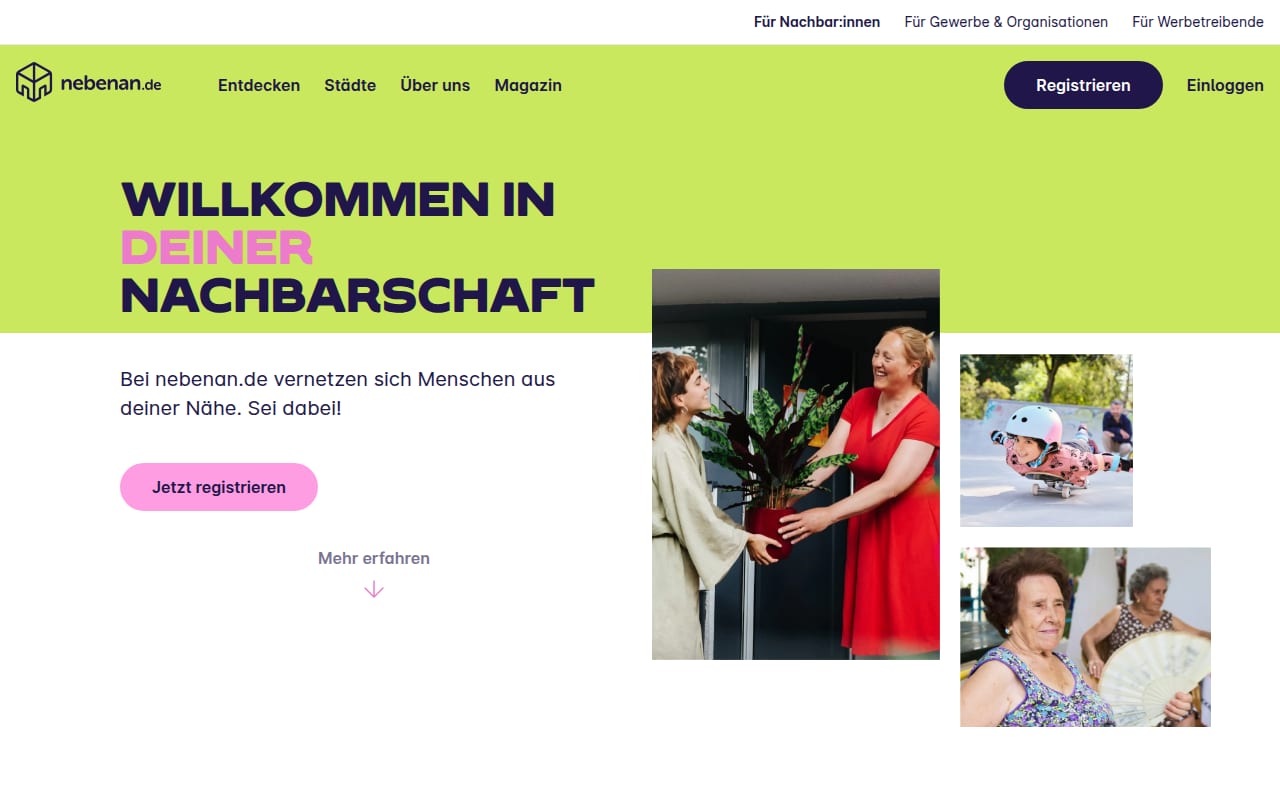
nebenan.de is a German neighbourhood network where only verified residents of the same area see each other’s posts: they lend tools, give things away, ask for help, recommend tradespeople and organise events. It is an alternative to Facebook groups and classified-ad sites for exchanges within one’s own neighbourhood.
A team around Christian Vollmann founded it in Berlin in 2015. Good Hood GmbH runs it, and since 2020 the media group Hubert Burda Media has held 61 % of the company. Joining needs a real name and address, checked by a code sent by post, a copy of an ID card or GPS location. In mid-2025 it reported 3.6 million active users and about 10,000 active neighbourhoods, with the most members in Berlin, Munich and Hamburg.
Use is free. The company earns money from paid profiles for organisations and councils, from local businesses (about 108,000 in mid-2025), from advertising and from voluntary monthly contributions by members. A separate non-profit, the nebenan.de Stiftung, has co-organised the German Neighbourhood Award (Deutscher Nachbarschaftspreis) since 2017. nebenan.de first promised not to use personal data for advertising, but its privacy policy since 2021 allows personalised ads and sharing data with third parties.
Strengths
- Only verified neighbours see the posts, so exchanges stay local and anonymous accounts are rare.
- Free to use, and built around lending, giving away and helping out rather than selling.
- The big cities have many active neighbourhoods: Berlin alone had more than 600,000 users in mid-2025.
Weaknesses
- Majority-owned by Burda, a media group, and funded partly by advertising and paid profiles.
- The privacy policy allows personalised advertising and sharing data with third parties, despite the platform’s early promises.
- Where few neighbours have joined, often in small towns, posts can go unanswered.
Who it is for
People in German cities who want to borrow, give away or ask for help close to home. Those who don’t want to give their address to a commercial platform may prefer a notice board or a local association.
Sources
- The official site nebenan.de could not be read automatically.
- Wikipedia: Nebenan.de
- Horizont: Burda übernimmt Mehrheit an nebenan.de