
Description
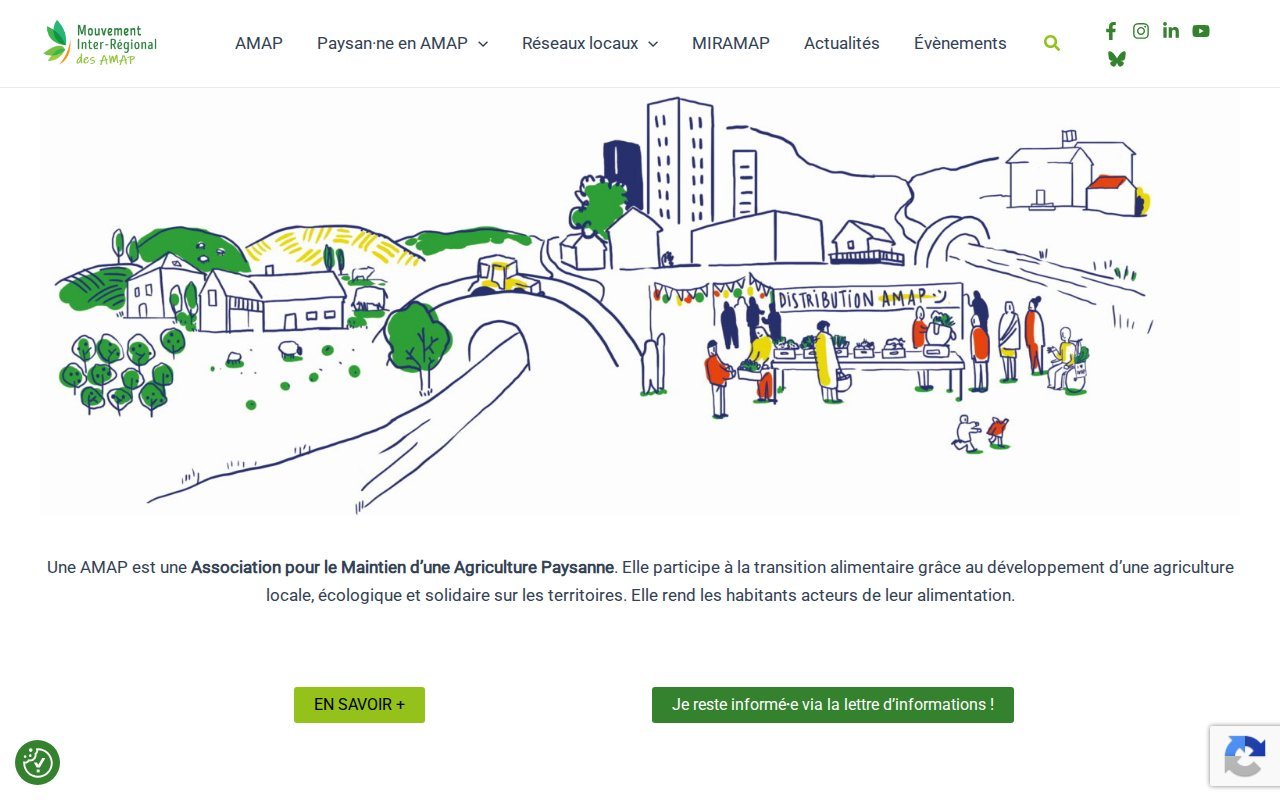
MIRAMAP is the national network of the AMAP (associations pour le maintien d’une agriculture paysanne), groups of consumers who sign a contract with a local farmer, pay for the harvest in advance and pick up a share every week. It is an alternative to supermarket fruit and vegetables from industrial farms and central buying offices.
The first AMAP handed out its baskets in Provence in April 2001, after the market gardeners Daniel and Denise Vuillon discovered community-supported agriculture in New York. MIRAMAP, an association founded in 2010 by the regional networks and based in Lyon, holds the AMAP trademark and the 2014 charter that every AMAP agrees to follow. It has three employees and 16 volunteer board members. According to MIRAMAP, France has more than 2,300 AMAP and 4,800 farmers selling through them.
At the start of the season, members sign a contract, usually for a year, and can spread the payments over several months. The price is set from the farmer’s costs and a fair income, not by weight, and members share the risk of a poor harvest. They also take turns running the weekly pick-up. Organic certification isn’t required, but the charter draws on organic and peasant farming and the food is often organic. There is no national directory: MIRAMAP points to a map of the local networks, and each AMAP sets its own prices.
Strengths
- A contract signed directly with the farmer, with a price based on production costs and fair pay rather than market prices.
- Payment in advance gives the farmer a secure income before the season, and members share the risk of a bad harvest.
- Fresh, seasonal produce, often organic, and contact with the farm through the pick-ups and help days.
Weaknesses
- Members commit for a season, usually a year, and pay the same even when a harvest is poor.
- Pick-up is at a fixed time and place each week, and members have to take their turn helping out.
- There is no national directory: one has to search the local networks’ map, and some areas have no active network.
Who it is for
Households in France who cook regularly, can collect a basket every week and want to support a nearby farmer for a whole season.
Sources
- MIRAMAP: home, le MIRAMAP, charte des AMAP, trouver une AMAP, checked November 2026
- Wikipédia: Association pour le maintien d’une agriculture paysanne