
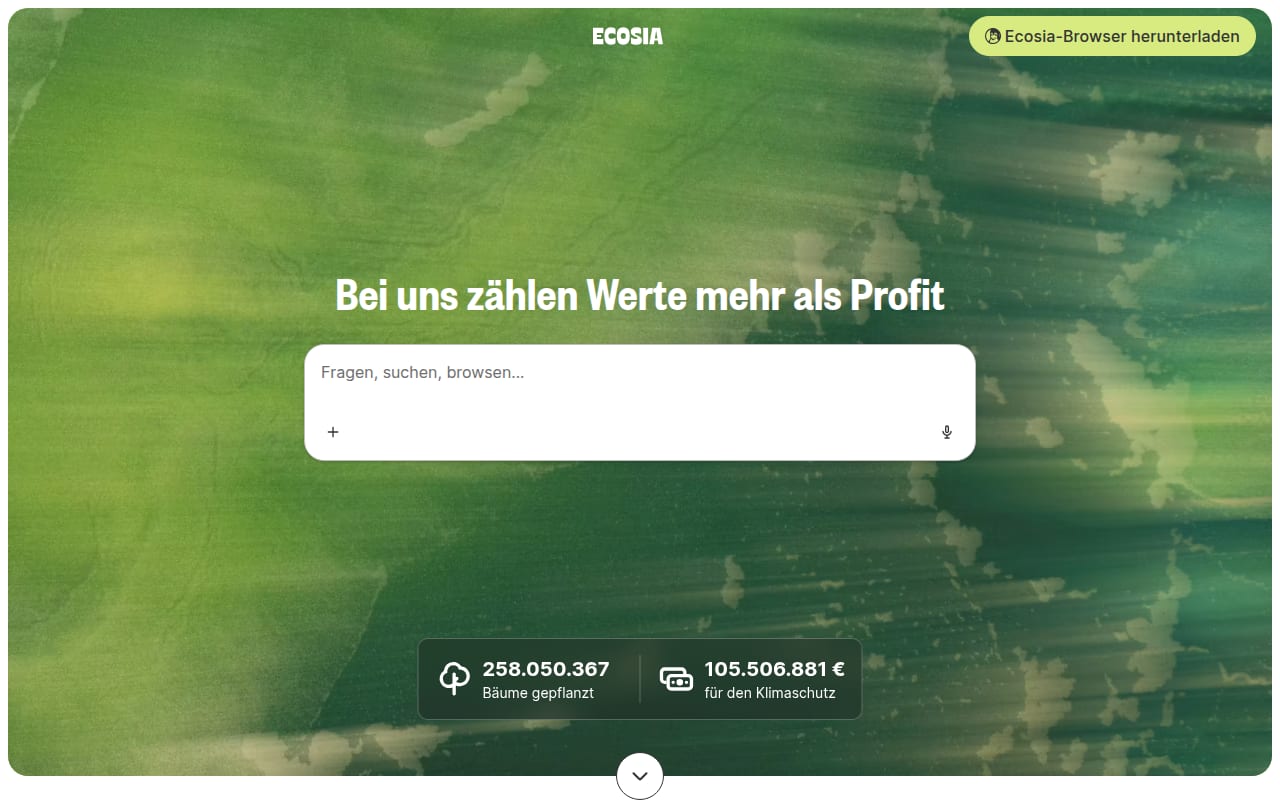
Description
Ecosia is a Berlin search engine that spends all its profits on climate action, mainly tree planting and renewable energy, and has been legally barred from being sold since it became steward-owned in 2018.
Christian Kroll founded it in 2009. Like other search engines it earns money when users click on the ads next to the results. In October 2018 it moved to steward ownership: a foundation holds a veto that blocks any sale or payout of profits. Ecosia publishes a financial report every month showing its income and what it spends on projects. By its own count it reached 250 million trees on 22 April 2026, counting only trees older than three years, with 125 partner organisations, and has invested more than €100 million in climate action, €18 million of it in renewable energy, including a 13 MWp solar park in Rottenbach built with Naturstrom.
Since 2025 Ecosia and the French search engine Qwant have built their own European search index through a joint venture, European Search Perspective. From 30 July 2026 it serves queries in Germany, and most of Ecosia’s French traffic already uses it; other results come from partner search engines. Ecosia is free, in a browser or as an app.
Strengths
- All profits go to climate projects, and steward ownership means the company can’t be sold to a buyer who would change that.
- It publishes monthly financial reports and counts only trees that have survived three years.
- It is building a European search index with Qwant instead of relying entirely on Google or Bing.
Weaknesses
- It is financed by search ads, so it still depends on people clicking on advertising.
- The tree and investment figures come from Ecosia itself and its partners, not from a single independent audit.
- Outside Germany and France, many results still come from partner search engines rather than from the European index.
Who it is for
People who search the web every day and want the ad money from their searches to go to tree planting and solar power instead of to shareholders.
Sources
- Ecosia blog: 250 million trees, EUSP rollout in Germany, solar park with Naturstrom, financial reports (checked November 2026)
- Ecosia support: reporting and transparency
- Wikipedia: Ecosia
- Next: Synfonium regroupe Qwant et Shadow