
Description
Crédit Coopératif is a French cooperative bank, owned by its client-members, that has banked associations and social-economy businesses since 1893 and also offers current accounts, cards and savings to individuals. It says it finances no fossil fuel extraction, and each of its cards gives a few cents per payment to a charity the client chooses.
It has more than 425,000 clients, more than 150,000 members with one vote each, and about 70 branches. It belongs to Groupe BPCE as a Banque Populaire, and BPCE guarantees its solvency and liquidity. Its “Agir” card gives about 5 to 12 cents per payment or withdrawal (sources differ) to a partner association. On the Livret Agir savings account, half the interest goes to a charity. These sharing products paid about 6.2 M€ to 50 associations in 2023.
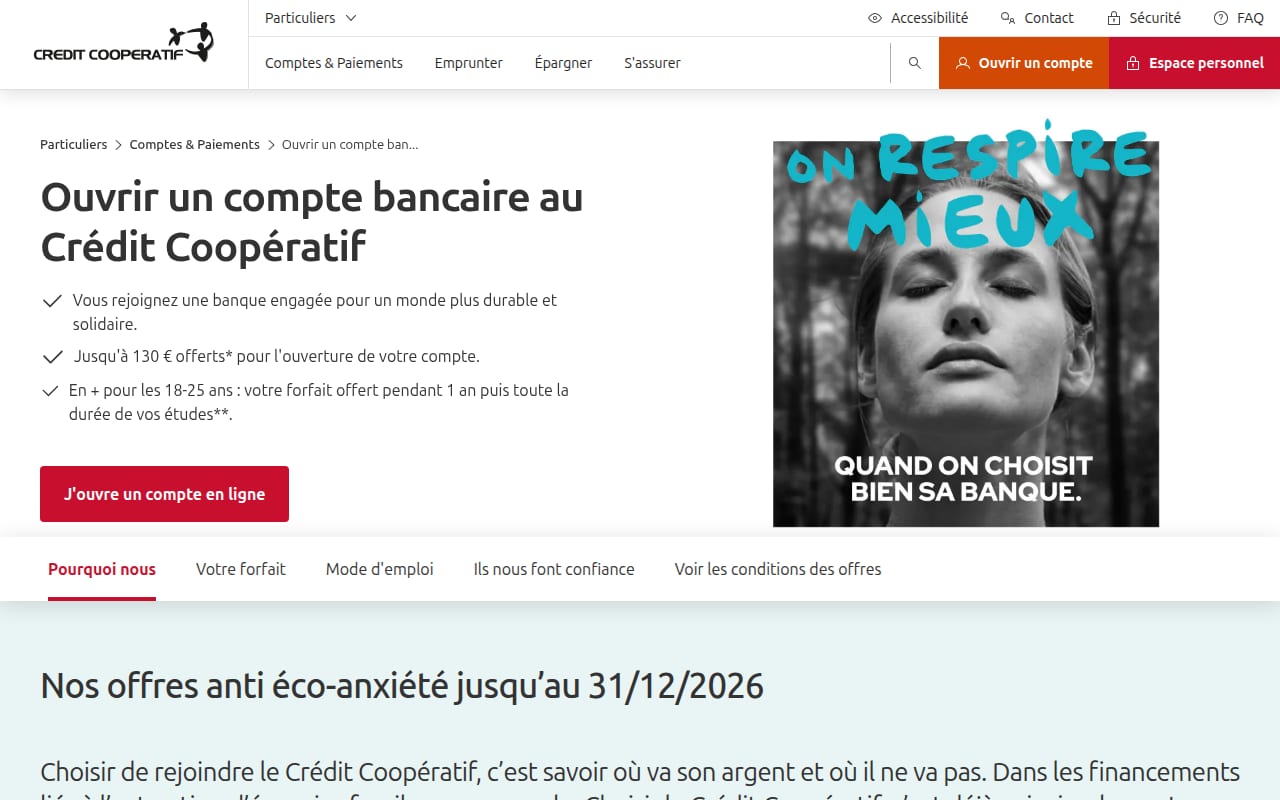
The packages cost 4 € a month for Simple d’Agir, from 8 € for Confort d’Agir and from 16.50 € for Libre d’Agir, with lower prices for 18 to 25-year-olds (MoneyVox, tariffs from January 2027, checked November 2026). Opening an account online needs a French tax residence and a first deposit of 300 €, or 150 € under 26. Les Amis de la Terre recommend it for a current account, while noting that it says less than La Nef about what the deposits finance.
Strengths
- Les Amis de la Terre praise its exclusion of coal, oil and gas and its low exposure to fossil fuels.
- Unlike La Nef, it has branches, current accounts, cards and loans for individuals, so it can replace a high-street bank entirely.
- Card donations and the Livret Agir send money to charities without extra cost to the client.
Weaknesses
- It belongs to Groupe BPCE, a mainstream banking group that guarantees its solvency, so it is less independent than La Nef.
- It publishes less detail than La Nef on which loans the deposits pay for.
- The 300 € opening deposit and the monthly package fees are higher than at online banks.
Who it is for
Households and associations in France that want a full-service bank with branches, owned by its members and away from fossil fuels, and that can pay a few euros a month for it.